Numerical precision
Standard double precision and eligible binary128-class calculations support work at different precision levels. Increased working precision does not guarantee the same number of correct digits.
Features & capabilities
From nonlinear algebra to scientific computing and multistage automation, Patodia Equation Solver 4.0 supports a deliberately broad selection of numerical problems.
The list below distinguishes service headers from the particular methods supported inside each service. Not every mathematically possible problem in a category is supported; use the documentation and solver diagnostics to check the applicable scope.
| Service keyword | Purpose | Scope |
|---|---|---|
solve | Algebraic equation solving | Linear/nonlinear systems; real roots, bounds and integer declarations. |
quad | Definite quadrature | Finite and supported infinite intervals; multiple ranges and declared singularities. |
compute | Compute Functions | Numerical expressions, mathematical and special functions, precision controls. |
diff | Differentiation | Selected derivatives, higher orders, gradients, Hessians and supported tabular calculations. |
limit | Limits | Finite and infinite approaches with numerical diagnostics. |
interpolate | Interpolation | Tabulated data, interpolation methods and query evaluation. |
ode | Initial-value ODEs | Scalar/coupled dynamics, specified initial data, adaptive or fixed steps. |
bvp | Boundary-value problems | Supported two-point ODE models with endpoint conditions. |
pde | Partial differential equations | Supported Laplace/Poisson, 1-D heat and wave problems. |
eigen | Eigenvalue problems | Supported Sturm–Liouville formulations, modes and eigenpairs. |
integral | Integral equations | Linear Fredholm and Volterra equations of the second kind. |
singularities | Singularity analysis | Inspect potential singular points over a specified range. |
A workflow uses named job headers such as quad area and closes a job with end. Standalone service scripts begin with the service keyword alone.
For supported equation systems, inspect candidate roots, bounds, maximum residuals and stopping reasons. Numerical solvers may identify several distinct answers without establishing that the list is complete.
Exact-integer techniques and supported number-theory models are treated separately from floating-point searches. Precision, resource limits and problem conditioning all affect what can be established.
See algebra and integer models →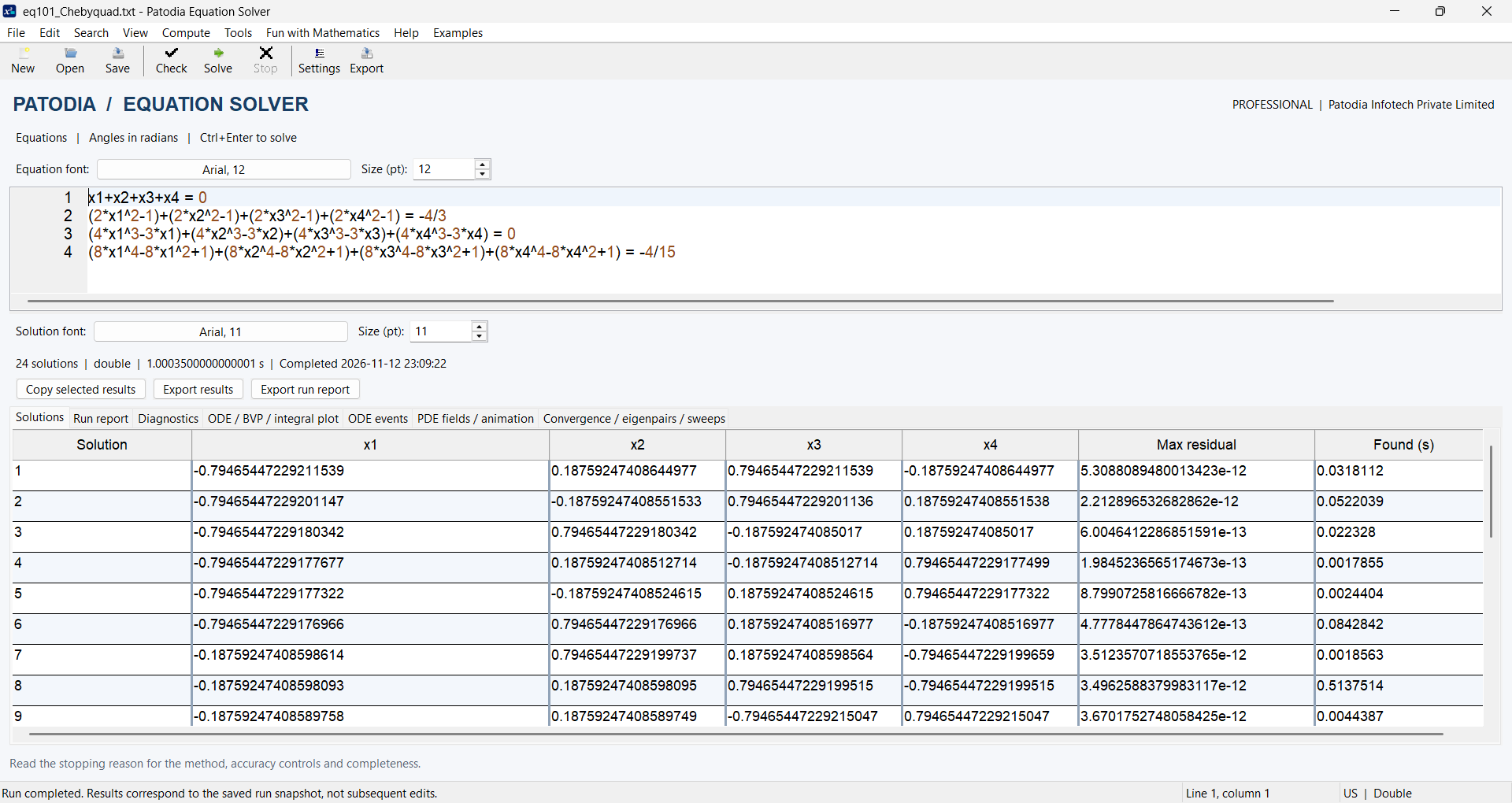
Standard double precision and eligible binary128-class calculations support work at different precision levels. Increased working precision does not guarantee the same number of correct digits.
Consult the status and reasons for termination, estimated errors when available, grid or output settings, and the original equation residuals. Independent checks are important for sensitive results.
The Windows editor, command-line executable and licensed DLL interfaces serve interactive, batch and permitted integration use cases. Specific capabilities depend on entitlement and the installed release.
Algebraic solver: find values satisfying equations. Quadrature: calculate a numerical definite integral. Differentiation: evaluate derivatives at a point. ODE: evolve a state from initial conditions. BVP: solve an ODE with conditions at different endpoints. PDE: calculate a field under supported domain and boundary assumptions. Integral equation: solve for a function appearing under an integral. Workflow: combine these services and summarize results in one program.
The Complete Features Brochure 4.0 PDF is available to read or download. Browse all six documents on the Resources page.
Open / Download PDF ↗Windows desktop · Version 4.0
Install the software, open the examples and examine the results.