1. Define the model
Translate the scientific or engineering relationship into simultaneous equations. Check units, parameter values and real domains.
Algebra & number theory
Formulate real equation systems, investigate nonlinear branches and apply supported integer methods without manually supplying algebraic starting guesses.
Many nonlinear systems have more than one valid real solution. The engine searches for distinct roots automatically using supported mathematical expressions, variable domains and settings. It reports numerical residuals and diagnostic information that help a user evaluate the discovered results.
var x,y
x^2 + y^2 = 25
x*y = 12
This system has four real solutions: (3,4), (4,3), (−3,−4) and (−4,−3). The keyword var is used to control the order in which variables are printed in solution output; the variables already occur in the equations. This display directive is not the same as the integration-variable setting in quad.
Polynomial, logarithmic, exponential and trigonometric expressions can be combined, subject to real-valued domains and supported parser rules. Practical bounds can narrow searches to physically relevant regions.
A small residual means that a reported candidate fits the supplied equations numerically; it does not certify that no other roots exist.
View real application outputs →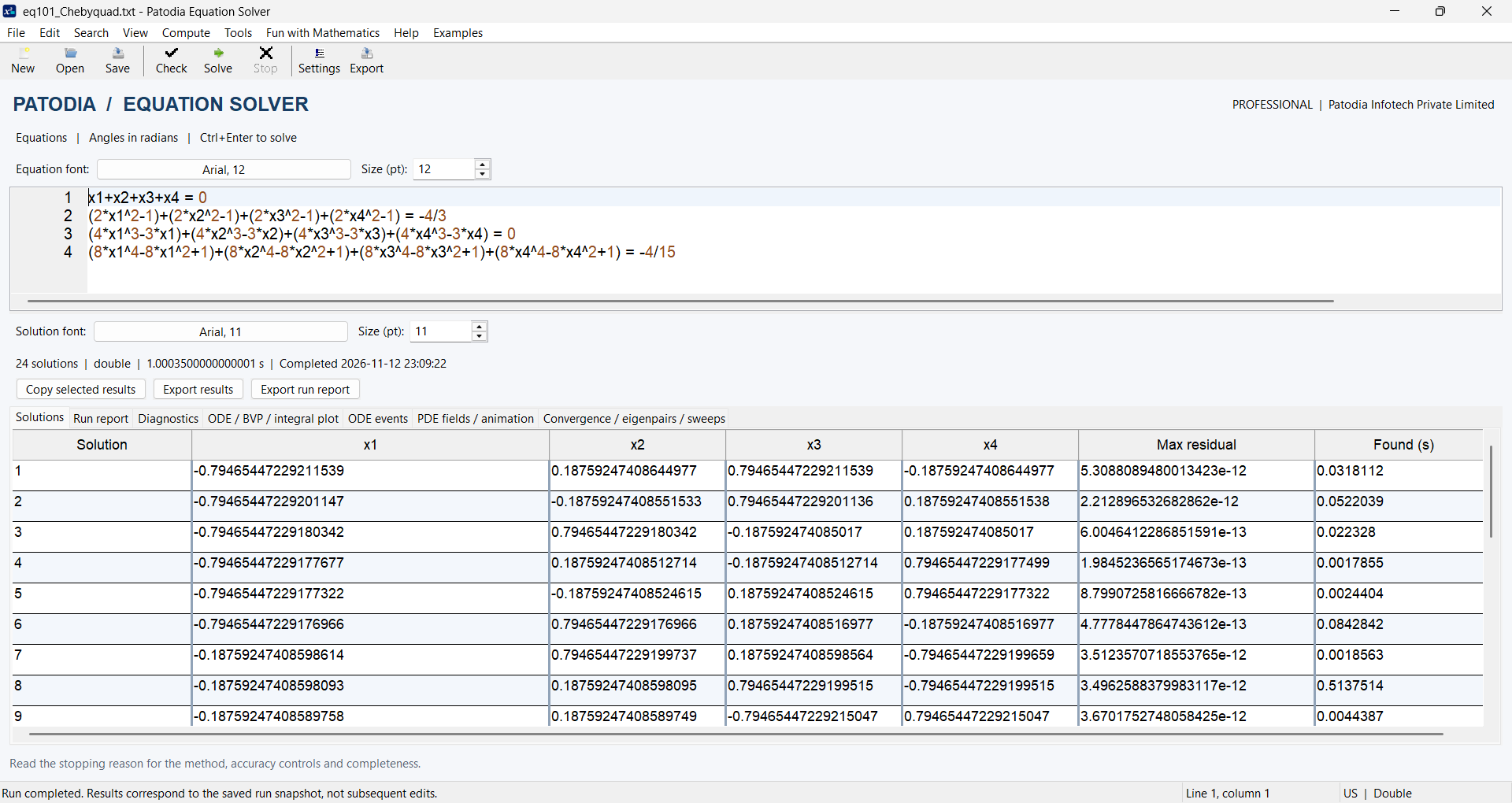
Use declarations such as int x,y and pos int x,y for supported discrete variables. Declare bounds to exclude irrelevant branches; supported exact-integer routes can handle large values without rounding every integer to a floating-point approximation.
pos int x,y
x^2 - 2*y^2 = 1
bound x = [1,1000]
bound y = [1,1000]
Pell-type equations illustrate why integer declarations matter. Other supported number-theory families include linear Diophantine equations, quadratic Diophantine forms and weighted sums of squares. Inspect the engine’s completion indicators for exact enumeration; they are distinct from ordinary numerical-search status.
Translate the scientific or engineering relationship into simultaneous equations. Check units, parameter values and real domains.
Use bounds or integer restrictions where they represent genuine mathematical or physical conditions, not arbitrary restrictions introduced after seeing the answer.
Compare all returned candidates with residuals and physical feasibility. Treat the stopping reason as part of the result.
The 100 Challenging Numerical Problems PDF is available to read or download. Browse all six documents on the Resources page.
Open / Download PDF ↗Windows desktop · Version 4.0
Install the software, open the examples and examine the results.